
Read our exhaustive, SEO-optimized analysis of the historic US-China $30billion tariff cut, trade council establishment, and the Super Intelligence (AI) dialogue agreed upon during President Xi Jinping’s Washington summit with President Donald Trump.
Navigating the New Geopolitical Equilibrium In The US-China $30Billion Tariff Cut
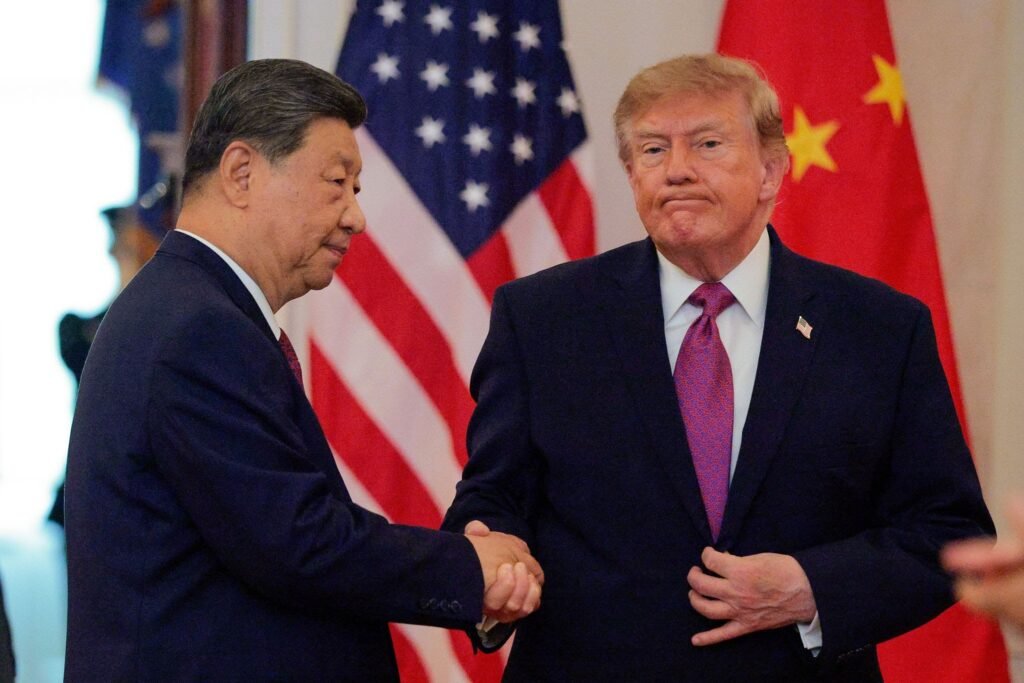
Image Courtesy: Washington Summit 2026. Source: Chip Somodevilla / Getty Images
The conclusion of the high-stakes, three-day Washington summit between United States President Donald Trump and Chinese President Xi Jinping marks a definitive inflection point in contemporary global economic governance.
Amid simmering systemic rivalry and complex technology controls, the world’s two largest economies have forged a pragmatic, eight-point consensus that dials back immediate trade hostility and sets the tone for bilateral management through late 2026.
RELATED: Navigating the Geopolitical Chessboard: Xi Jinping Tests Donald Trump with the “Thucydides Trap”
Examining these talks for US News Forum, this milestone agreement is much more than a temporary truce or a tactical photo-op.
It establishes institutionalized channels for commercial stabilization, supply chain coordination, and technological risk-mitigation.
In this comprehensive feature, we examine the fine print of the eight-point framework, explore the implications of the $30 billion tariff cut, analyze the strategic adoption of Super Intelligence (SI) governance, and project what this means for global markets and multinational investors.
Unpacking the Eight-Point US-China Washington Consensus
While the three-day summit deliberately avoided a sweeping grand bargain on deeply contested structural issues, the pragmatic architecture successfully extends trade stability.
Building directly upon prior foundational dialogues held in Busan and Kuala Lumpur, the administration successfully eased tariff friction on non-sensitive consumer, agricultural, and medical device categories.
Comprehensive Matrix of the Eight-Point Agreement
| Policy Area | Key Action / Mechanism | Economic & Strategic Impact |
| Tariff Reductions | Reciprocal cuts covering $30 billion of non-sensitive goods in each direction. | Lowers cost barriers for consumer items, toys, small appliances, agricultural goods, seafood, and medical devices. |
| Technology Governance | Launch of the Super Intelligence (SI) Dialogue and an incident communication channel. | Establishes formal risk-mitigation lines for next-generation automated systems, with November follow-up sessions. |
| Trade & Investment Councils | Establishment of structured boards of trade and investment. | Provides institutional mechanisms to resolve commercial frictions and streamline cross-border market access. |
| Supply Chain & Minerals | Ongoing coordination to restore appropriate shipment levels of rare earths and critical minerals. | Alleviates critical industrial bottlenecks for Western manufacturing while meeting Chinese compliance frameworks. |
| Global Energy & Petroleum | Joint initiatives to expand agricultural market access and stabilize petroleum supply. | Curbs inflationary pressures on global commodities and safeguards energy stability. |
| Geopolitical Security & Maritime | Alignment on non-proliferation (Iran) and open transit on international waterways. | Reassures international shipping lanes and reduces geopolitical flashpoints. |
| Military Crisis Communication | Implementation of a Memorandum of Understanding (MoU) for military crisis prevention. | Lowers the risk of operational misunderstandings in the Indo-Pacific theater. |
| Bilateral Summits | Mutual support and attendance at upcoming APEC and G20 leader gatherings. | Institutionalizes continuous high-level dialogue through late 2026 and beyond. |
Decoding the Strategic Pivot on “Super Intelligence” (AI)
One of the most fascinating linguistic and structural takeaways from the White House and Xinhua joint readouts is the deliberate adoption of the term “Super Intelligence” (SI) instead of conventional “Artificial Intelligence” (AI) for high-level bilateral risk management.
By framing the dialogue around Super Intelligence, Washington and Beijing are signaling a shared acknowledgment that frontier models present systemic, cross-border safety challenges that transcend ordinary software regulation.
- Risk Mitigation: The creation of an immediate communication channel for AI-related incidents acts as a digital-age “hotline,” preventing algorithmic anomalies or automated cyber triggers from cascading into geopolitical crises.
- Structured Cadence: With the next round of SI discussions locked in for November, both governments are institutionalizing tech governance, separating high-stakes technological collaboration from daily tariff disputes.
President Trump noted that while the US maintains a dominant lead in technology development, open communication lines are essential to prevent dangerous escalations.
Supply Chains, Rare Earths, and the $30 Billion Trade Calculus
The $30 billion tariff relief package is meticulously calibrated.
By focusing on non-sensitive consumer goods, agricultural products, and medical devices, both administrations managed to deliver tangible economic relief to domestic constituencies without triggering protectionist backlashes in Congress or the National People’s Congress.
Furthermore, progress on critical minerals—specifically addressing US supply shortages of rare earths in exchange for relaxed export restrictions—demonstrates a pragmatic realization of economic interdependence.
Neither economy can decouple entirely without suffering severe structural inflation.
Coupled with long-term commitments such as agricultural market access and petroleum supply stabilization, these talks provide vital predictability for global supply chains heading into early 2027.
Macroeconomic Fallout and Market Repercussions
Financial markets have responded with cautious optimism to the Washington summit outcomes.
For years, investors have priced in worst-case decoupling scenarios between the world’s dual economic engines.
The creation of a dedicated bilateral trade council, coupled with the extension of the previous trade truce framework, signals that both capitals prefer managed competition over destructive economic warfare.
Multinational corporations operating across tech, manufacturing, and consumer goods sectors now possess a clearer window of regulatory visibility through the remainder of 2026.
However, analysts emphasize that vigilance remains essential.
While tariff reductions on non-sensitive goods provide immediate margin relief, core semiconductor export controls, advanced computing restrictions, and national security investments remain strictly guarded by both superpowers.
Conclusion: What This Means for Global Markets
The Xi-Trump Washington summit proves that economic realism can temporarily trump maximalist confrontation.
While fundamental systemic competition between Washington and Beijing remains entrenched, the establishment of the $30 billion tariff reduction, trade councils, and the Super Intelligence dialogue creates a predictable framework for global markets heading into late 2026.
For investors, policymakers, and multinational corporations, this diplomatic alignment translates into reduced tail-risk and greater visibility across international markets.
Frequently Asked Questions (FAQ)
What was the main outcome of President Xi Jinping’s Washington visit?
The visit resulted in an eight-point consensus, featuring a $30 billion reciprocal tariff reduction on non-sensitive goods, the launch of a Super Intelligence (AI) dialogue, the establishment of a trade council, and enhanced military crisis communication channels.
Which goods are covered under the $30 billion tariff cut?
The tariff reductions apply symmetrically to non-sensitive commercial categories, including US agricultural products, seafood, wood, and medical devices, as well as Chinese consumer goods, small appliances, toys, and decorations.
Why did the US and China use the term “Super Intelligence” instead of AI?
Both nations agreed to use “Super Intelligence” (SI) to focus specifically on frontier technological risks, safety guardrails, and systemic challenges that require direct bilateral incident-management channels.
How does this agreement affect global supply chains and rare earths?
The consensus includes mechanisms to normalize shipments of rare earths and critical minerals, easing manufacturing bottlenecks and stabilizing international trade flows through January 2027.