
Explore a comprehensive news analysis of Chinese President Xi Jinping’s strategic deployment of the “Thucydides Trap” concept during his summit with US President Donald Trump, examining great-power rivalry, diplomatic signaling, and global implications.
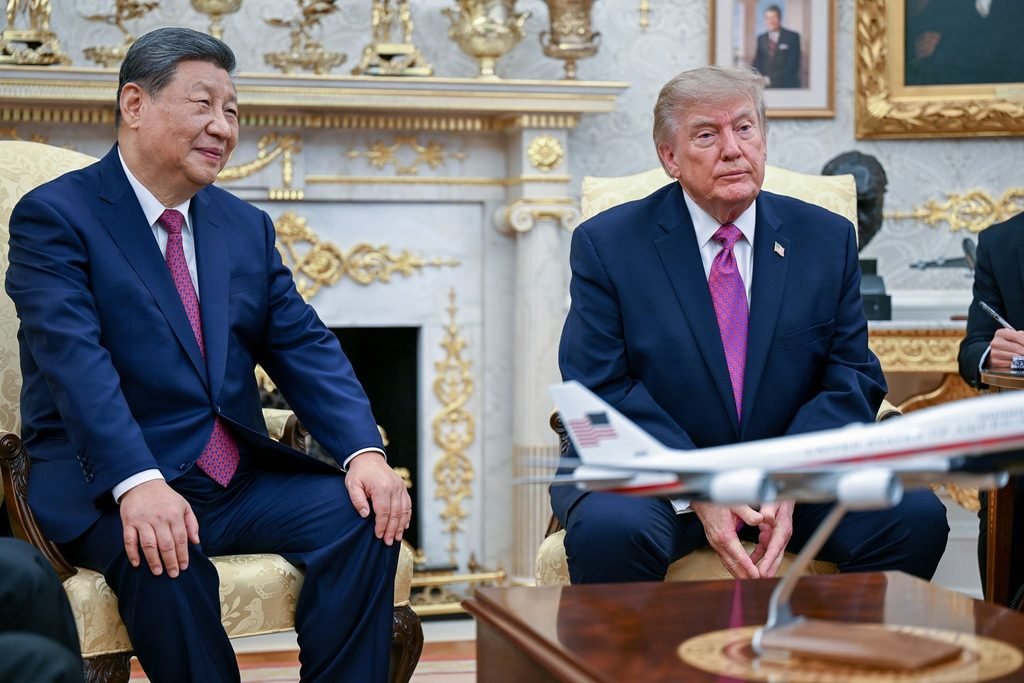
Image Courtesy: Xi Jinping and Donald Trump meeting at the White House. Source: Bloomberg / Bloomberg via Getty Images
The modern geopolitical landscape is defined by an invisible yet constant tension.
This tension is the friction between an established global hegemony and a rapidly ascending challenger.
This fundamental structural stress was brought to the forefront during a high-stakes diplomatic summit at the White House.
RELATED: With Trump-Xi Truce, China Looks to Reshape Asian Order?
Chinese President Xi Jinping explicitly invoked a legendary historical framework to address US President Donald Trump.
By declaring that the “Thucydides Trap” CAN be overcome, Xi framed the overarching narrative of twenty-first-century statecraft.
This comprehensive news analysis explores the deep historical roots of this concept.
It dissects the diplomatic postures of both leaders.
It evaluates the domestic and international reactions.
Finally, it assesses what this encounter means for the future of global stability.
Understanding the Roots: What is the Thucydides Trap?
To fully comprehend the weight of Xi Jinping’s diplomatic messaging, one must examine the origins of the phrase.
Coined by renowned Harvard political scientist Graham Allison, the Thucydides Trap draws its name from the ancient Athenian historian Thucydides.
In his seminal account of the Peloponnesian War, Thucydides identified a recurring, dangerous dynamic.
This dynamic was the growth of Athenian power and the fear that this instilled in Sparta, which made war inevitable.
Allison applied this timeless historical pattern to modern international relations.
He studied 16 cases throughout history where a rising power threatened to displace a ruling hegemon.
The statistical findings of Allison’s research remain a sobering warning for modern policymakers.
Out of 16 historical cases, 12 ended in violent conflict.
When Xi Jinping stood at the White House and asserted that this trap is not an inescapable destiny, his message was multifaceted.
He was simultaneously acknowledging the monumental structural rivalry between Beijing and Washington while extending an alternative path of managed competition.
The White House Summit: Xi’s Diplomatic Strategy
During the welcome ceremony with President Trump seated beside him, Chinese President Xi Jinping delivered a carefully calibrated address.
Rather than resorting to traditional Cold War rhetoric or projecting overt hostility, Xi chose a sophisticated formulation of great-power coexistence.
Key elements of Xi’s strategic messaging included several distinct points:
- Partners, Not Rivals: Xi argued that the grand rejuvenation of China and Donald Trump’s stated ambition to “Make America Great Again” do not have to be mutually exclusive.
- Predictable Peace: He called for a bilateral framework where competition remains moderate, strategic differences are actively managed, and peace is treated as a predictable baseline rather than a fragile illusion.
- Implicit Burden-Shifting: By stating that the Thucydides Trap can be overcome, Xi implicitly placed the psychological and strategic burden on the United States. His framing challenges the established power to resist viewing China’s inevitable rise as an existential, zero-sum threat.
Donald Trump’s Response and Washington’s Polarized Reaction
President Donald Trump responded with a surprising display of personal warmth.
He steered away from the intense economic and trade antagonism that historically characterized his administration’s posture toward Beijing.
Describing Xi as a “great leader,” Trump emphasized the strength of their personal rapport.
He stated that the United States and China shared a “great relationship.”
However, this amicable public display instantly triggered fierce backlash within the American political establishment:
- Criticism from the Opposition and Media: Prominent publications and political critics lambasted Trump, branding him a “Deferential President.” Critics pointed to imagery of the US President hosting or waiting for foreign counterparts as evidence of a shifting global hierarchy.
- The Hardline Counter-Perspective: Washington hawks and national security critics argued that Beijing’s soothing rhetoric stands in stark contrast to its aggressive military expansion, persistent pressure around Taiwan, and expanding global footprint. They contend that the US cannot afford to rely on benign intentions.
- Pragmatic Realism: Offering a more sobering institutional perspective, Secretary of State Marco Rubio defended high-level engagement. Rubio noted that it would be diplomatically irresponsible not to engage Beijing at the highest level despite deep-seated structural differences, emphasizing that US-China relations will single-handedly define the 21st century.
Comparative Analysis: Historical vs. Modern Power Transitions
To evaluate the likelihood of whether the US and China can successfully evade the Trap, it helps to compare historical hegemonic transitions with the current 2026 paradigm.
| Analytical Dimension | Historical Precedents (e.g., Athens vs. Sparta) | Modern US-China Dynamic (2026) |
| Interdependence | Low economic integration; distinct regional spheres. | Deep economic entanglement, global supply chains, and financial codependency. |
| Nuclear Deterrence | Absent; total war was an unconstrained policy option. | Absolute; Mutually Assured Destruction (MAD) raises the cost of direct kinetic conflict to an unacceptable threshold. |
| Global Commons | Contested regional trade routes and localized alliances. | Globalized challenges including climate change, cybersecurity, pandemics, and space exploration. |
| Nature of Competition | Zero-sum territorial and military domination. | Multi-dimensional: technological supremacy, economic dominance, artificial intelligence, and ideological influence. |
Global Repercussions: The View from Other Capitals
While Washington and Beijing dance through this delicate diplomatic tango, other global players are watching with acute anxiety.
For instance, India has frequently found its bilateral relationship with Washington described as the defining partnership of the century.
Now, India witnesses the US pivot back to high-stakes direct engagement with China.
Middle powers across Europe and the Indo-Pacific are forced to recalibrate their foreign policies.
The fear of being caught in the crossfire of a new bipolar cold war means that nations are increasingly pursuing strategic autonomy.
They are hedging their bets between American security guarantees and Chinese economic gravity.
Conclusion
Xi Jinping’s invocation during his summit with Donald Trump was not merely a rhetorical flourish.
It was a sophisticated psychological and strategic maneuver.
By acknowledging the structural anxieties inherent in a shifting global order while simultaneously offering a framework for peaceful coexistence, Beijing aims to constrain American containment efforts.
At the same time, it seeks to cement its status as an equal global pillar.
Whether Washington can navigate this historic transition without falling into the traditional traps of past superpowers remains the defining question of our era.
As Secretary of State Marco Rubio noted, this relationship will define the 21st century.
This reality makes clear-eyed realism, robust deterrence, and open diplomatic channels more crucial than ever before.
Frequently Asked Questions (FAQ)
Q1: What is the Thucydides Trap?
A: This is a political science concept coined by Graham Allison. It describes the natural, structural tension that occurs when a rising power threatens to displace a ruling global hegemon, historically often resulting in war.
Q2: Why did Xi Jinping bring up the Thucydides Trap during his meeting with Donald Trump?
A: Xi invoked the concept to address the underlying tensions between the US and China directly. By stating that the trap can be overcome, he signaled that China desires peaceful, managed competition rather than an inevitable military conflict with the United States.
Q3: How did Donald Trump react to Xi Jinping’s overtures?
A: President Trump responded with notable warmth, praising Xi as a “great leader” and emphasizing their personal relationship, which contrasted sharply with the aggressive, hawkish rhetoric often favored by critics and past administrations.
Q4: What was the reaction in Washington to the summit?
A: Washington’s political establishment was deeply divided. Critics accused Trump of projecting weakness and being overly deferential, while pragmatic officials like Secretary of State Marco Rubio defended high-level engagement as an absolute necessity for managing global stability.