

Explore an insightful news analysis of the US Supreme Court rejecting Donald Trump’s push to set aside California mail ballots.
Discover the legal implications, Trump’s strategy, and impact on midterm elections.

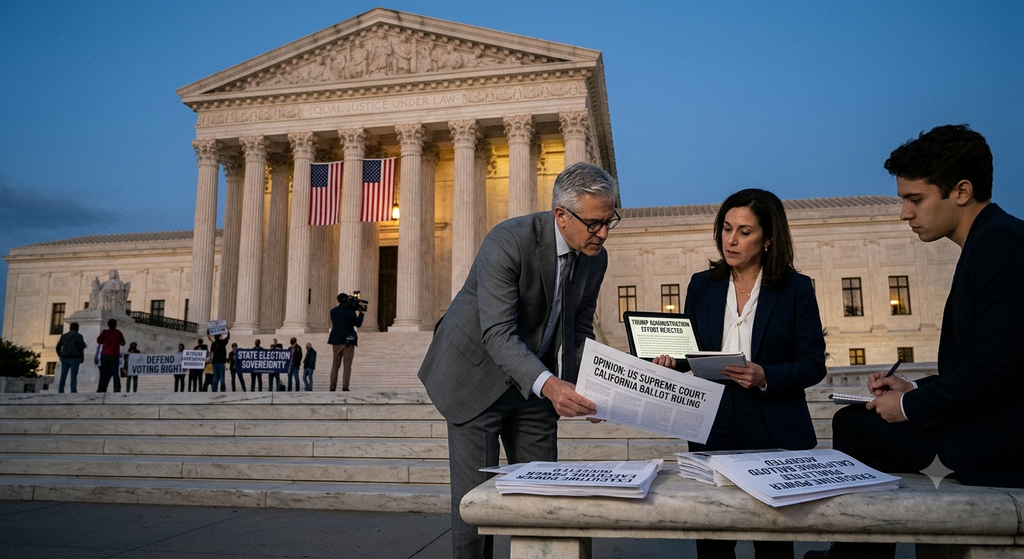
The political landscape in the United States often plays out as a high-stakes chess match between executive ambition and institutional checks and balances.
A prime example of this dynamic unfolded when the US Supreme Court rejected Donald Trump’s push to set aside California ballots just hours before the final day of voting in crucial midterm elections.
For political observers and news analysts, this unanimous-feeling emergency ruling—where no justices publicly dissented—offers a fascinating lens through which to examine President Donald Trump’s political attitude, legal strategies, and relentless pursuit of election oversight.
Analyzing Donald Trump’s Attitude Toward Election Integrity and Federal Power
When evaluating Donald Trump’s political posture through this latest legal maneuver, several distinct traits of his administrative and political strategy stand out:
- Aggressive Pre-Election Intervention: Trump’s administration has consistently demonstrated a willingness to utilize emergency judicial dockets right up to the wire. Waiting until weeks before the election to challenge voter rolls reflects an aggressive, high-pressure approach to shaping the electorate.
- Skepticism of State-Run Electoral Systems: The challenge underscores a deep-seated distrust—or tactical skepticism—toward state-administered voting systems, particularly in Democratic strongholds like California. By questioning voter rolls, the administration continually casts doubt on the validity of mail-in voting.
- Prioritizing Narrative Over Logistical Reality: Even when Department of Justice (DOJ) attorneys openly conceded that their flagged voter list contained a high error rate, the administration pushed forward. This highlights an attitude where political signaling and establishing a narrative on noncitizen voting take precedence over meticulous administrative accuracy.
The Legal Battle Over California Mail-In Ballots: What Happened?
The core of the US Supreme Court legal showdown involved approximately 20,000 mail-in ballots in California that the Trump administration claimed belonged to noncitizens.
With over 23 million registered voters receiving mail-in ballots in the state since early October, millions of votes were already in motion.
Also Read: The Ultimate Swing State: What is Inside the Georgia Midterm Elections Battleground
Federal district courts and a 2-1 appeals court panel firmly blocked the administration’s demands.
US Supreme Court Judges warned that segregating these ballots on short notice would “wreak havoc” on the election, create logistical chaos, and effectively disenfranchise thousands of legal US citizens due to unverified data.
Key Dimensions of the Legal Dispute
| Dimension | Trump Administration Stance | California State & Lower Courts Stance |
| Primary Objective | Set aside 20,000 flagged ballots to prevent potential illegal noncitizen voting. | Protect legal voters from disenfranchisement and maintain election integrity. |
| Data Reliability | Argued it was a modest request to verify citizenship status eventually. | Highlighted high error rates in DOJ data and impossibility of last-minute sorting. |
| Constitutional Argument | Asserted federal oversight rights in federal elections. | Cited the Elections Clause, arguing executive branch overreach into state powers. |
Examining Trump’s Hardline Strategy and Last-Minute Legal Challenges
The US Supreme Court‘s swift refusal to intervene highlights the limits of executive power when colliding with established state election laws and logistical realities.
Yet, Trump’s persistent focus on noncitizen voting—despite data showing it is statistically rare—serves a dual purpose.
On one hand, it rallies his base around the core theme of election security.
On the other hand, it tests the boundaries of how far the executive branch can stretch federal authority into state-administered jurisdictions.
Chief Judge James Boasberg aptly noted during a parallel Washington ruling that the Executive Branch likely violated the Constitution’s Elections Clause, which explicitly assigns authority over election rules to states and Congress.
Despite stinging losses across multiple federal courts—with judges appointed by both Republicans and Democrats ruling against the administration—Trump’s team remained defiant.
You May Like This: Astrotourism in the USA: Best Places to Experience the Night Sky
Local federal prosecutors expressed high confidence in their targets, even while admitting flaws in the source data.
This stubborn refusal to back down is a hallmark of the Trump political playbook: keep pressure on the system, challenge institutional norms, and frame pushback as proof of systemic resistance.
Frequently Asked Questions on the US Supreme Court California Ballot Ruling
Why did the US Supreme Court reject Trump’s California ballot push?
The Supreme Court issued a swift emergency rejection without detailing its reasoning, which is standard practice for emergency docket appeals.
Lower courts had already ruled that the administration’s demand was logistically impossible and risked disenfranchising legal voters due to high error rates in the flagged data.
How many ballots were affected by the Supreme Court ruling?
The administration’s push targeted roughly 20,000 mail-in ballots in California that the Department of Justice flagged as potentially belonging to noncitizens.
What did lower courts say about the administration’s request?
Federal judges strongly criticized the timing and accuracy of the request. District Judge David O. Carter warned that segregating ballots based on unproven allegations would “wreak havoc” on the midterm elections and endanger democracy, while Chief Judge James Boasberg stated the Executive Branch likely violated the Constitution’s Elections Clause.
Conclusion
The US Supreme Court’s rejection of the Trump administration’s California ballot push is more than just a footnote in a busy election cycle; it is a revealing window into Donald Trump’s political methodology.
By persistently challenging state-run voting processes right up to election eve—despite acknowledging data flaws and facing unanimous judicial resistance—Trump signals an uncompromising commitment to keeping election integrity at the forefront of national discourse.
As the dust settles on the midterms, this clash between federal pressure and state autonomy will continue to shape the American electoral landscape for years to come.