

The road to congressional power in the United States runs directly through the American South. No state embodies this political tug-of-war quite like Georgia.
As the final hours tick down toward next week’s highly anticipated vote, the Georgia midterm elections have transformed into a high-stakes arena.

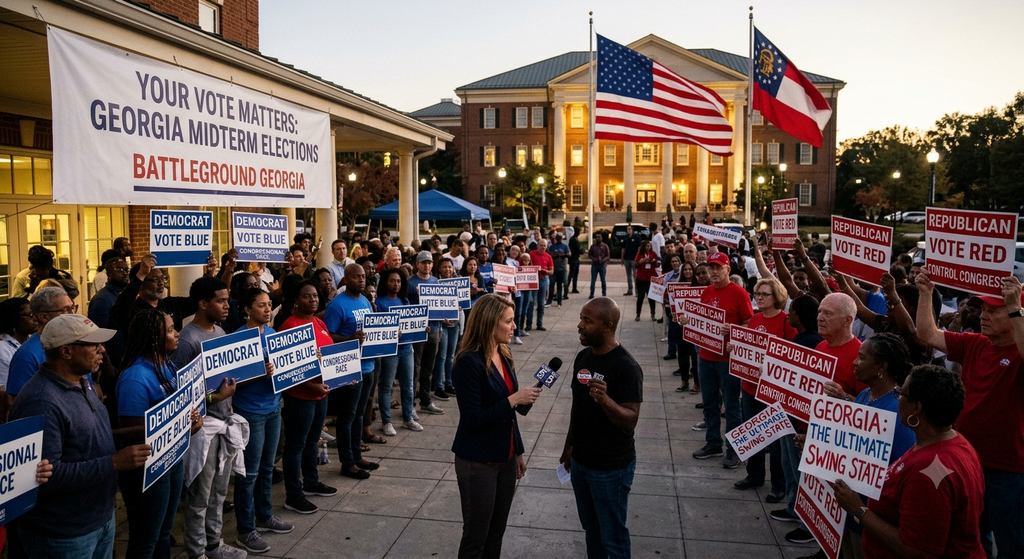
Credits: Gemini
Former President Barack Obama and current President Donald Trump are going head-to-head to rally their respective bases.
For political strategists and casual observers alike, the question isn’t just who will win the Peach State. It is how the outcome will reshape the entire balance of power in Washington.
The Swing State Georgia’s recent history of razor-thin margins and consecutive Senate runoffs has cemented its status as a premier political battleground.
The Swing state continues to draw hundreds of millions of dollars in campaign spending and the undivided attention of the nation’s most powerful figures.
Why the Georgia Midterm Elections Matter Nationwide
To understand the intensity surrounding the Georgia midterm elections, one must look at the recent electoral trajectory of the state. For decades, Georgia was a reliable stronghold for the Republican Party.
Rapid demographic shifts, urbanisation in the Atlanta metropolitan area, and intensive voter registration drives have turned the state into a genuine “purple” toss-up.
President Donald Trump’s focus on the state is deeply personal and highly strategic.
After narrowly losing the state in 2020, Trump has returned to campaign extensively, targeting working-class hubs like Dalton.
Though a state election interference case against him was dismissed following his return to the White House, the political scars remain fresh.
Trump carried The Swing State Georgia by a 2.2 percentage point margin in 2024. This proves that while the state leans conservative under certain conditions, it sits on a political knife-edge where a shift of just a few thousand votes can alter national policy.
Georgia Midterm Elections: Senate Race Polling: Ossoff vs. Collins
The battle for the U.S. The Senate in Georgia presents a fascinating contrast in campaign styles, ideologies, and polling trajectories.
Democratic incumbent Senator Jon Ossoff is fighting to retain the seat he historically won in a 2021 runoff election.
As the first Jewish senator from Georgia and the youngest Democrat elected to the chamber in nearly forty years, Ossoff represents the changing face of the New South.
According to recent Georgia Senate race polling averages compiled by MS NOW, Ossoff currently maintains a solid lead of 52.6 percent compared to 42.4 percent for his Republican challenger, Mike Collins. This data has led major networks like NBC to forecast the race as “Likely Democratic”.
The stakes for this race were highlighted at a recent rally where Donald Trump openly warned voters that federal cooperation would depend on their choice.
You May Like This: Kyiv Missile Attack Escalates Amid Fresh US Ukraine Diplomacy and Peace Push
Trump stated that Collins would have direct access to the White House to secure federal aid for Georgia.
However, Trump mocked Ossoff, claiming he would ignore any requests from the Democratic incumbent.
Georgia Governor Race Polling: Bottoms vs. Jackson
While the Senate race shows a clear frontrunner, the Georgia governor race polling paints a far more volatile picture.
With incumbent Republican Governor Brian Kemp barred by term limits from seeking a third consecutive term, the executive mansion in Atlanta is entirely up for grabs.
Political analysts at NBC have officially classified the gubernatorial contest as a pure “toss-up”. The two candidates offering competing visions for the state could not be more polarized:
Keisha Lance Bottoms (Democrat)
The former Mayor of Atlanta is attempting to make history as the first Black woman ever elected as a U.S. governor.
Bottoms is framing her campaign around steady leadership, increased education funding, environmental regulations, and expanded healthcare access.
Her campaign positions her as an institutional bulwark capable of delivering for working families while insulating Georgia from the ongoing political chaos in Washington.
Rick Jackson (Republican)
A 72-year-old billionaire businessman, Jackson is utilizing his vast personal wealth to reshape the narrative around the race.
Jackson has poured over $200 million of his own money into an aggressive advertising blitz.
His campaign focuses heavily on law and order, specifically targeting Bottoms’ record on crime during her tenure as Atlanta’s mayor.
Jackson’s advertisements frequently feature footage of civil unrest and demonstrations from 2020 following the fatal shooting of Rayshard Brooks by an Atlanta police officer, using it as a visual argument against Democratic governance.
Key Matchups in the Georgia Midterm Elections
Beyond the marquee Senate and gubernatorial races, voters across the state are deciding the composition of the state’s delegation to the U.S. House of Representatives. They are also voting on vital state-level administrative roles.
The outcomes of these down-ballot contests will dictate how effectively the next governor can implement policy.
| Office / District | Democratic Candidate | Republican Candidate | Current Political Status & Context |
| U.S. Senate | Jon Ossoff (Incumbent) | Mike Collins | Ossoff holds a comfortable 10.2-point lead in MS NOW polling; NBC rates it as “Likely Democratic.” |
| Governor | Keisha Lance Bottoms | Rick Jackson | Deadlocked toss-up to succeed Brian Kemp. High spending on crime vs. healthcare messaging. |
| U.S. House Delegations | 5 Current Seats | 9 Current Seats | 14 total congressional districts are up for election, determining federal house control. |
| State Executive Offices | Various Nominees | Various Nominees | Lieutenant Governor, Attorney General, and Secretary of State are all on the ballot. |
The Impact of Early Voting Trends in Georgia
A critical factor that could disrupt all polling models is the massive surge in early voter participation.
According to data compiled by the University of Florida’s election lab, more than 40 million Americans have already cast their ballots through early in-person voting or mail-in options.
Georgia has historically outpaced many states in early voting turnout. With the national total rapidly approaching the 45.9 million early votes recorded during the entirety of the 2022 midterms, election administrators in Georgia are preparing for historic turnout.
High early voting numbers generally suggest a highly energized electorate, though political scientists caution against assuming it inherently favors one party over the other.
It changes the traditional Election Day dynamic, forcing campaigns to expend resources much earlier in the cycle to capture votes before November.
Main Takeaways from the Georgia Midterms
The upcoming vote in Georgia represents more than a local political transition.
It serves as a referendum on the competing national visions put forth by the Biden-Trump era and the emerging political alignments of the South.
- A Divided Electorate: Georgia remains the ultimate litmus test for political strategy. The clear split between a “Likely Democratic” Senate seat and a “Toss-Up” Governor’s race demonstrates that Georgia voters are highly discerning, often separating the individual candidate’s appeal from broader national party trends.
- The Power of Local Issues: While Donald Trump and Barack Obama dominate national headlines with high-profile arguments over corruption and presidential legacies, local races are being fought on concrete issues. These include healthcare access, inflation, education funding, and public safety.
- Unprecedented Financial Warfare: With candidates like Rick Jackson injecting hundreds of millions of dollars of personal wealth into local media markets, Georgia sets a new standard for campaign spending. It shows how modern elections are increasingly driven by sustained, high-cost advertising campaigns.
Frequently Asked Questions (FAQ)
When do the Georgia midterm elections take place?
The final day of voting for the midterm elections takes place next week, following several weeks of active early and mail-in voting across the state.
Who is leading the Georgia Senate race polling?
Incumbent Democrat Jon Ossoff holds a significant lead, polling at 52.6 percent to Republican challenger Mike Collins’ 42.4 percent according to MS NOW polling averages.
Why is the Georgia Governor race considered a toss-up?
Democratic candidate Keisha Lance Bottoms and Republican billionaire Rick Jackson are locked in a very tight race to succeed outgoing Governor Brian Kemp. Polling shows no clear leader alongside massive spending on both sides.
How many congressional seats does Georgia have in the House of Representatives?
Georgia is represented by 14 congressional districts in the U.S. House of Representatives. Going into next week’s election, the delegation consists of nine Republicans and five Democrats.