

Kyiv hits missile strikes just hours after Russia agreed in principle to resume Ukraine peace talks with US envoys. Dive into our expert analysis on peace diplomacy, Starlink limits, and sanctions relief.
The contrast between diplomatic rhetoric and the reality on the ground in Eastern Europe has rarely been so stark.

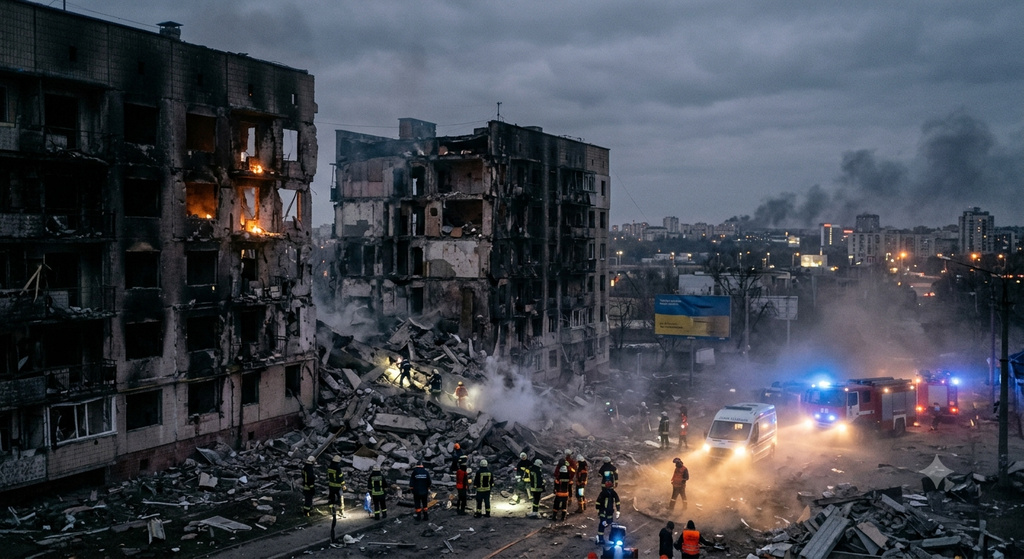
Credits: Gemini
Just hours after United States envoys reported breakthroughs in preliminary peace discussions with Moscow, Ukrainian air defense systems were once again engaged over the capital city of Kyiv.
ALSO READ: Ukraine Russia Drone Strikes Escalate: 1,000 Drones Target Russian Energy Hubs
A fresh Kyiv missile attack rattled residential districts on Wednesday night, leaving at least six civilians injured and several homes destroyed, according to Kyiv Mayor Vitaliy Klitschko.
This assault came precisely as global headlines broadcast a dramatically different narrative: that the world was closer than ever to ending the deadliest conflict in Europe since World War II.
Four countries sign defense cooperation pact in Qatar
Speaking on Wednesday, U.S. President Donald Trump declared that negotiations were approaching a critical turning point, remarking:
“The other day I was talking to Vladimir Putin about settling his war with Ukraine, which I think we’re getting closer to, by the way, maybe now the closest we’ve been.”
Yet, as incoming missiles continue to fall on Ukrainian cities, foreign policy analysts and military experts are left dissecting a volatile dual reality.
Can high-level diplomatic channels truly secure a lasting ceasefire, or are these renewed negotiations simply serving as tactical leverage while fighting intensifies on the front lines?
US Ukraine Diplomacy in Action: The Donald Trump Ukraine Peace Plan Steps Forward
The recent diplomatic push has been spearheaded by key U.S. representatives, notably Special Envoy Steve Witkoff and Jared Kushner.
Following intensive high-level briefings in Oslo with Ukrainian President Volodymyr Zelensky alongside the heads of state of Norway and Finland, Witkoff traveled directly to St. Petersburg to meet face-to-face with Russian President Vladimir Putin.
Meanwhile, Kushner joined the deliberations remotely via secure video link.
While full details surrounding the broader Donald Trump Ukraine peace plan remain closely guarded by international diplomats, early reports indicate that discussions centered heavily around two core pillars:
- Ironclad security guarantees designed to ensure long-term sovereign stability for Ukraine.
- Targeted energy ceasefire proposals aimed at halting reciprocal infrastructure destruction.
Kremlin Assessment of Preliminary Peace Frameworks
Despite envoy Steve Witkoff describing the meeting in St. Petersburg as “constructive,” the response from Moscow remains measured and cautious.
Kremlin senior foreign policy aide Yuri Ushakov offered a lukewarm assessment, publicly characterizing some of the preliminary American ideas as “not very useful.”
However, Ushakov did confirm that Moscow remains open in principle to continuing formal engagement.
A potential next round of three-way diplomatic meetings focused on Ukraine peace talks has been tentatively scheduled for November 10 in Abu Dhabi, United Arab Emirates.
Ushakov emphasized that any viable future agreements must focus squarely on “building a security system for Russia and Ukraine after the end of the conflict.”
Concurrently, Moscow reiterated its stance that Russian forces hold the “strategic initiative” across the entire front line—a claim vigorously disputed by Kyiv and its European allies, who characterize the current territorial dynamic as a heavily contested stalemate.
Russia Ukraine War Update: Volodymyr Zelensky Ceasefire Demands and Frontline Facts
To contextualize the vast gap between geopolitical rhetoric and operational facts on the ground, the table below breaks down the contrasting perspectives currently defining the conflict:
| Strategic Focus Area | Ukrainian Position | Russian Position | U.S. Diplomatic Stance |
| Territorial Control | Rejects permanent loss; open to a line-of-contact freeze as a temporary measure to stop civilian casualties. | Asserts control over ~20% of Ukrainian territory; claims active advancement across all sectors. | Pushing for an immediate ceasefire (“stop killings”) to freeze hostilities along current front lines. |
| Security Guarantees | Demands robust, enforceable international security guarantees prior to long-term political settlements. | Demands a complete overhaul of regional security structures prioritizing Russian strategic buffer zones. | Seeking a balanced framework for “lasting peace, security, and prosperity” for future generations. |
| Energy & Infrastructure | Seeks an immediate halt to missile and drone strikes targeting national power grids and energy hubs. | Uses energy infrastructure targeting as a primary lever to diminish defensive capacity. | Advocating for targeted energy sector ceasefires as an initial trust-building measure. |
| Sanctions & Economics | Opposes premature sanctions relief without definitive Russian military concessions and withdrawal. | Demands full lifting of Western economic sanctions, tariffs, and trade restrictions. | Recently eased select energy sanctions to stabilize international oil markets and domestic fuel prices. |
Friction in US Ukraine Diplomacy: Assessing the Volodymyr Zelensky Ceasefire Position
While shuttle diplomacy continues across European capitals, strategic tensions between Washington and Kyiv have visibly intensified.
A series of political and operational friction points have highlighted growing rifts between the allies:
1. Leadership Dynamics and Negotiations
President Trump has voiced mounting frustration over the pace of negotiations, suggesting publicly that Ukraine may require new leadership or alternative negotiators to break the diplomatic deadlock.
These statements have caused significant unease among European partners, who view President Zelensky’s mandate as essential to preserving national sovereignty and cohesion.
2. Sanctions Relief and Economic Policy Shifts
Tensions escalated further following decisions by the U.S. administration to temporarily roll back select energy sanctions on Russian oil exports.
The policy shift was designed to release diesel supplies into global supply chains to combat rising fuel prices—partially triggered by geopolitical volatility linked to U.S. operations involving Iran.
Zelensky and several European leaders sharply criticized the move, arguing that economic sanctions relief removes vital leverage over Moscow before a verified ceasefire is achieved.
“We call it ‘ceasefire’ or ‘stop killings’ like President Trump called it. Freeze and stop. And of course this is the minimum that we need from Russia today.”
— Volodymyr Zelensky, President of Ukraine
3. Tactical Intelligence Flows and Satellite Access
Military coordination has faced operational hurdles as well:
- Intelligence Delays: Kyiv recently raised formal concerns regarding brief disruptions in real-time U.S. tactical intelligence sharing, which Ukrainian officials argued impaired early-warning systems for incoming ballistic missiles.
- U.S. Secretary of State Marco Rubio firmly rejected allegations of intentional withholding, and Zelensky later confirmed that intelligence flows have been fully restored.
- Starlink Network Restrictions: Ukrainian military operators reported operational slowdowns affecting Starlink satellite bandwidth, impacting drone reconnaissance operations along active conflict sectors. While U.S. officials denied ordering network restrictions, bipartisan congressional leaders have requested a formal inquiry into the disruption.
De-escalation Signals: Key Milestones in the Russia Ukraine War Update
Amid geopolitical friction, the release of high-profile detainees has emerged as a traditional indicator of diplomatic movement.
Immediately prior to the St. Petersburg conference, Russian authorities released Stephen Hubbard, a 74-year-old American citizen who had been sentenced to nearly seven years in prison following allegations of fighting alongside Ukrainian forces.
The release was executed without a direct exchange of prisoners. U.S. Vice President JD Vance defended envoy Steve Witkoff’s pragmatic diplomatic approach, noting that securing the release of an American citizen remains a vital objective regardless of broader political disagreements over rhetoric:
“Steve Witkoff is a diplomat. His job is to go over there and get a job done. I care much less about what Steve said than about the fact that he is bringing an American hostage home to his family.”
— JD Vance, Vice President of the United States
What Lies Ahead for Ukraine Peace Talks: The Road to Abu Dhabi
As the diplomatic narrative moves toward the proposed November 10 summit in Abu Dhabi, global observers face a complex landscape.
On one hand, the willingness of Washington, Moscow, and Kyiv to engage in structured talks offers a potential avenue toward reducing violence.
On the other hand, persistent missile strikes against civilian centers like Kyiv underscore how fragile these tentative agreements remain.
Achieving a lasting resolution through the Donald Trump Ukraine peace plan will likely depend on addressing core operational questions:
- Enforcement Mechanisms: How can a line-of-contact freeze be monitored and verified without risking immediate re-escalation?
- Security Commitments: What binding guarantees will satisfy Ukraine’s core defensive needs while providing a stable political framework for regional security?
- Alliance Unity: How effectively can Western allies reconcile economic policy, sanctions strategy, and long-term military support to maintain a unified position?
Until these fundamental questions are resolved, the contrast between diplomatic discussions in foreign capitals and air raid sirens over Kyiv will remain a defining feature of the conflict.
Frequently Asked Questions (FAQ)
What triggered the recent Kyiv missile attack?
The strikes occurred on Wednesday night as Russian forces launched missile salvos hitting residential areas in Kyiv, injuring six people. The attack took place shortly after Russia expressed willingness “in principle” to resume peace talks facilitated by U.S. envoys.
Who are the key diplomats leading US Ukraine diplomacy?
The diplomatic effort is led by U.S. Special Envoy Steve Witkoff and Jared Kushner, working alongside U.S. President Donald Trump, Ukrainian President Volodymyr Zelensky, and senior Russian foreign policy advisor Yuri Ushakov.
What is the Volodymyr Zelensky ceasefire proposal?
President Zelensky has indicated an openness to an immediate ceasefire that freezes military positions along the current front lines—stopping active strikes and casualties as an initial step before broader security guarantees and territorial status are negotiated.
Where and when are the next formal Ukraine peace talks scheduled?
According to Kremlin representative Yuri Ushakov, the next round of formal three-way talks between top U.S., Russian, and Ukrainian officials is being targeted for around November 10 in Abu Dhabi, United Arab Emirates.