

In one of the most extensive and coordinated aerial operations since the outbreak of full-scale hostilities, Ukraine Russia drone strikes reached a critical new threshold over the weekend.

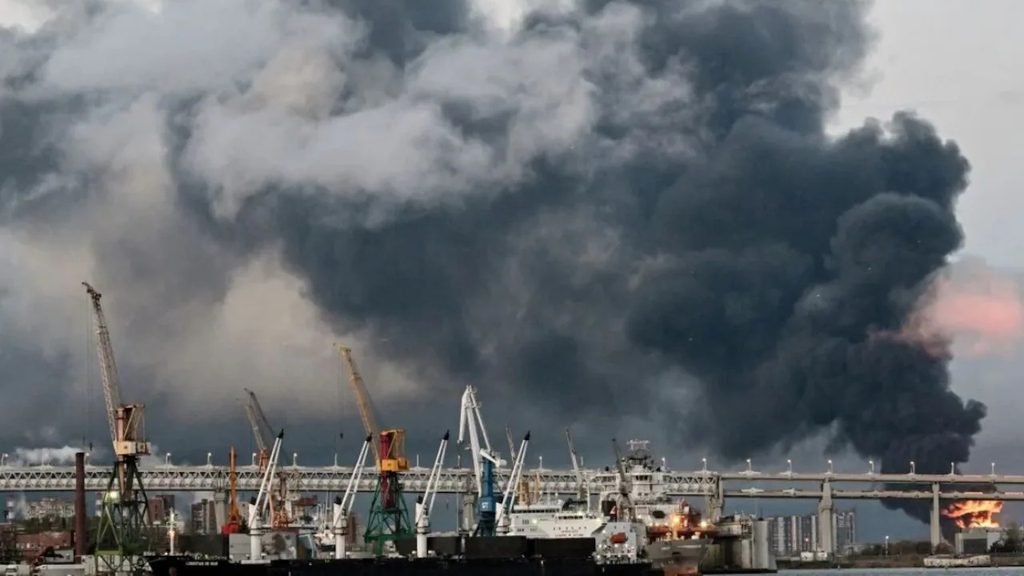
Image Courtesy: AFP
Ukrainian forces deployed a massive swarm of over 1,000 long-range unmanned aerial vehicles (UAVs) deep into Russian territory.
The strategic barrage successfully targeted and set ablaze critical petroleum and commercial logistical hubs across St. Petersburg, severely disrupting regional supply chains and exposing acute vulnerabilities in Russia’s air defense umbrella.
This dramatic escalation occurs at a delicate geopolitical juncture in the 4.5-year conflict.
As key international stakeholders seek mechanisms to de-escalate the destruction of continental energy networks, the scale of these strikes underscores Kyiv’s intent to maintain maximum pressure on Moscow’s economic engine.
The operational execution of this Ukraine Russia drone strikes wave has not only triggered local emergency responses across multiple Russian provinces but has also intensified high-stakes strategic debates between Ukrainian leadership and international partners regarding the management of critical infrastructure warfare.
St. Petersburg Oil Terminal Attack Disrupts Russian Infrastructure
The St. Petersburg oil terminal attack stands out as one of the most ambitious deep-strike missions executed by Ukrainian intelligence and special forces to date.
Situated on the Gulf of Finland, St. Petersburg serves as Russia’s premier Baltic gateway for refined petroleum exports.
Disrupting operations at this maritime terminal directly impacts Russia’s ability to move oil products to international buyers via sea lanes, creating immediate operational and financial bottlenecks.
Local authorities, including regional Governor Alexander Beglov, confirmed that drone impacts sparked major blazes at both the Petersburg Oil Terminal and the neighboring Ruchi oil depot.
Firefighting crews were deployed in high-capacity operations to suppress petroleum-fueled fires that sent dense plumes of smoke over the industrial perimeter.
The casualty count in Ukraine Russia drone strikes included one individual killed and at least five others injured during the initial strike wave and subsequent structural fires.
Strategic Expansion to Commercial and Digital Targets
Unlike previous strike waves that concentrated almost exclusively on military airfields, munitions dumps, or regional refineries, this operation targeted broader commercial and digital nodes:
- E-Commerce and Logistics Networks: A major distribution center belonging to Ozon—one of Russia’s primary e-commerce platforms—suffered direct structural damage. This interruption severely impacted local order fulfillment and exposed how vulnerable commercial logistics hubs are during broad-spectrum drone operations.
- Digital Infrastructure: Local tech titan VK (formerly VKontakte) confirmed that a primary data center facility was struck during the raid. The targeting of data infrastructure highlights a conscious tactical move to disrupt digital communications, corporate cloud operations, and internal network stability alongside physical energy supply chains.
According to statements issued by the Russian Ministry of Defense, air defense units engaged and destroyed approximately 1,015 Ukrainian drones across 15 distinct regions, as well as over the annexed Crimean peninsula and the Black Sea.
However, the sheer volume of incoming saturation attacks overwhelmed point-defense systems around St. Petersburg, allowing multiple warheads to reach high-value targets.
In immediate response to the northern strikes, Russian forces initiated retaliatory attacks against southern Ukrainian urban centers.
In Zaporizhzhia, two separate strikes damaged two residential apartment complexes, 18 private vehicles, and a local educational facility. According to Mykhailo Semikin, head of the Zaporizhzhia Regional Military Administration, the strikes resulted in the death of a woman and injured several civilians, including a 6-year-old child.
The Fragile Status of the Ukraine Energy Ceasefire
The intense operational tempo of these strikes underscores the operational failure of the proposed Ukraine energy ceasefire.
Conceived as a bilateral framework to halt long-range strikes against electrical grids, power plants, gas pumping stations, and petroleum refineries, the agreement has collapsed under the weight of continuous tactical violations and divergent strategic objectives.
While diplomatic representatives from Washington initially indicated that both belligerents had consented to cease attacks on critical energy assets, ground realities quickly diverged from political declarations.
Ukrainian President Volodymyr Zelenskyy clarified that although Kyiv initially respected a brief three-day operational pause, continuous Russian bombardments against Ukrainian municipal power grids left the nation with no choice but to resume defensive counter-strikes against Russian fuel supplies.
Breakdown of the Ceasefire Framework
In an official public communication, President Zelenskyy outlined the empirical data behind Kyiv’s decision to resume strikes against Russian energy infrastructure:
- Persistent Grid Bombardment: In the seven days following the public announcement of the energy ceasefire, Russian forces launched 76 separate strikes targeting Ukrainian energy, oil, and natural gas facilities across multiple provinces.
- Widespread Civilian Power Outages: A single overnight attack impacted electrical infrastructure across four Ukrainian regions, leaving tens of thousands of civilian households without electricity, heating, or water services.
- Strategic Asymmetry: Kyiv argued that adhering to a unilateral pause while Moscow actively targets civil utilities creates a dangerous asymmetry that threatens national survival ahead of winter.
“America should see that Russia is not taking any reciprocal steps in response to sanctions relief or agreements. On the contrary, they take every signal of an opportunity to make money as proof that their bet on war is paying off and they can keep fighting,” President Zelenskyy emphasized.
Kyiv’s rationale remains grounded in the concept of active deterrence: as long as Russian strategic forces seek to impose winter blackouts on Ukrainian cities, Ukrainian forces will utilize long-range drone capabilities to curtail Russian refining capacity and foreign oil revenues.
Trump Ukraine Russia Policy Under Growing Pressure
The geopolitical ripple effects of the Trump Ukraine Russia policy have added significant complexity to an already volatile military situation.
The current U.S. administration has attempted to balance two competing imperatives: bringing both sides to the negotiating table through economic leverage, while simultaneously preventing broader global energy shocks that could trigger domestic inflation and international market instability.
President Donald Trump publicly expressed frustration with Ukraine’s decision to resume deep strikes against Russian oil facilities, arguing that targeting global energy nodes complicates diplomatic negotiations.
Simultaneously, the White House has executed major policy shifts regarding financial sanctions against Moscow.
Sanctions Policy and Executive Action
A cornerstone of the administration’s recent strategy involved the execution of an executive order that effectively paused and waived planned financial restrictions against specific Russian entities.
Citing pressing “U.S. national security interests,” the administration defended the move as a necessary measure to keep global energy supply lines stable and maintain open channels for diplomatic mediation.
During a recent address at a fundraising event in Florida, President Trump addressed inquiries regarding potential future sanctions against Moscow:
“We’ll figure it out, and you’ll figure it out. But it’s a very good decision, and it’s going to be a decision that’s good for the country, and I think good for the world,” Trump remarked regarding his administration’s tactical adjustments on sanctions.
Strategic Divergence Between Washington and Kyiv
This approach has generated noticeable friction between U.S. policy planners and the Ukrainian military command:
- The Washington Perspective: U.S. policy seeks to prevent sudden spikes in global crude oil prices, protect international maritime trade in the Baltic and Black Seas, and create a stable baseline for potential peace negotiations.
- From this vantage point, Ukrainian strikes on major commercial ports like St. Petersburg introduce uncontrollable variables into global energy markets.
- The Kyiv Perspective: Ukrainian leadership views Russian oil exports as the financial foundation funding the invasion. From Kyiv’s point of view, waiving sanctions without demanding an absolute, verifiable cessation of Russian missile strikes on Ukrainian cities undermines Western solidarity and provides Moscow with the economic resources needed to sustain a prolonged war of attrition.
Historical Context of Energy Warfare in the Conflict
To fully grasp the magnitude of the recent St. Petersburg oil terminal attack, one must evaluate how energy infrastructure has functioned as both a weapon and a primary target throughout the 4.5-year war.
During the initial years of the conflict, long-range bombardment was largely asymmetrical.
Russian strategic bomber fleets and naval platforms launched waves of cruise and ballistic missiles at Ukrainian thermal power plants, transformer substations, and hydroelectric dams.
The objective was clear: shatter the civilian energy grid and degrade industrial production.
However, the rapid maturation of Ukraine’s domestic defense industry transformed this dynamic.
By developing long-range, low-cost attack UAVs capable of navigating hundreds of kilometers through dense electronic warfare environments, Ukraine established its own strategic strike capability. The operational focus shifted systematically:
- Regional Refineries (2023–2024): Initial strike missions targeted localized Russian fuel storage facilities and regional refining towers within 300 kilometers of the border.
- Export Terminals (Present): Current operations target massive maritime export infrastructure—such as the Baltic facilities at St. Petersburg and Ust-Luga—located over 800 kilometers from Ukrainian launch sites.
This evolution indicates that Ukraine now possesses both the technical logistics and intelligence gathering necessary to execute massed, multi-vector saturation attacks deep inside Russian space.
Economic and Global Market Analysis
The economic ramifications of sustained Ukraine Russia drone strikes against energy assets extend far beyond the immediate tactical damage measured at the Petersburg Oil Terminal.
The Gulf of Finland serves as Russia’s primary maritime gateway for crude and refined products bound for international markets.
Impacts on Global Petroleum Supply Chains
- Refining and Storage Deficits: When primary storage depots and loading facilities are damaged, oil producers are forced to slow down extraction or reroute crude supplies to secondary, less efficient pipelines.
- Shipping and Insurance Risk: Successful drone strikes in major shipping corridors drastically increase insurance premiums for commercial tankers operating in the Baltic Sea, raising the overall baseline cost of Russian crude exports.
- Secondary Market Volatility: As refined product outputs drop, global futures markets for diesel, gasoline, and heating oil experience rapid price volatility, directly affecting international energy consumer pricing.
The strike on commercial targets like Ozon and VK introduces an additional layer of economic uncertainty.
Foreign investors and domestic Russian businesses must now factor in physical war risk for facilities located in major metropolitan areas far removed from the frontline combat zones of eastern and southern Ukraine.
Conclusion: Strategic Implications for the Conflict Ahead
The massive surge in Ukraine Russia drone strikes and the execution of the St. Petersburg oil terminal attack signaled a decisive shift in the war’s operational trajectory.
Kyiv’s demonstrated capability to launch over 1,000 long-range unmanned systems in a single operational wave proves that its strategic deep-strike program has achieved industrial scale.
By hitting critical oil export infrastructure alongside commercial logistics and tech hubs, Ukraine has shown that it can impose severe economic costs directly on the Russian heartland.
At the same time, the breakdown of the Ukraine energy ceasefire highlights the profound difficulty of establishing temporary operational pauses in a high-intensity war of attrition.
As long as Russian strikes continue to target Ukrainian municipal power grids, Kyiv will continue to view Russian energy infrastructure as a legitimate and necessary military target.
Moving forward, the primary strategic variable remains the evolution of the Trump Ukraine Russia policy.
As Washington attempts to navigate the delicate balance between enforcing energy market stability, managing Western alliance cohesion, and pursuing a diplomatic resolution, the conflict continues to be defined by high-stakes infrastructure warfare.
Unless international diplomatic efforts can establish verifiable, reciprocal enforcement mechanisms, energy networks and maritime logistics hubs will remain the central operational battleground of the conflict.
Frequently Asked Questions (FAQ)
What specific targets were struck during the St. Petersburg oil terminal attack?
The primary targets included the Petersburg Oil Terminal and the Ruchi oil depot, both of which suffered structural fires.
Secondary commercial targets hit during the broad drone raid included an e-commerce fulfillment center owned by Ozon and a corporate data center operated by Russian technology company VK.
Why did the proposed Ukraine energy ceasefire fail to hold?
The energy ceasefire broke down due to a lack of verifiable reciprocity.
Although Ukraine initially paused deep strikes against Russian oil facilities, Russian forces executed 76 separate attacks on Ukrainian energy, gas, and electrical infrastructure within a single week following the ceasefire announcement. This prompted Kyiv to resume counter-strikes against Russian petroleum assets.
How is the Trump Ukraine Russia policy affecting financial sanctions on Russia?
The current administration executed an executive order waiving planned financial sanctions against certain Russian entities, citing U.S. national security interests and global energy market stability.
While Washington continues to push for a complete halt to energy grid strikes, Kyiv has voiced concerns that waiving sanctions without reciprocal Russian concessions rewards Moscow’s continued air strikes.
What is the broader economic impact of 1,000-drone swarm attacks on Russian ports?
Massive drone attacks on major export terminals like St. Petersburg disrupt refined petroleum supply chains, raise maritime shipping insurance rates in the Baltic Sea, and force Russian energy firms to divert exports to secondary routes.
Furthermore, striking logistics hubs (like Ozon) and digital infrastructure (like VK) spreads economic disruption directly into Russia’s domestic commercial sector.