

Explore how Russia’s daytime drone strikes on Kyiv’s science academy, advanced jet munitions, and border incidents near Poland fuel a worsening European security crisis.

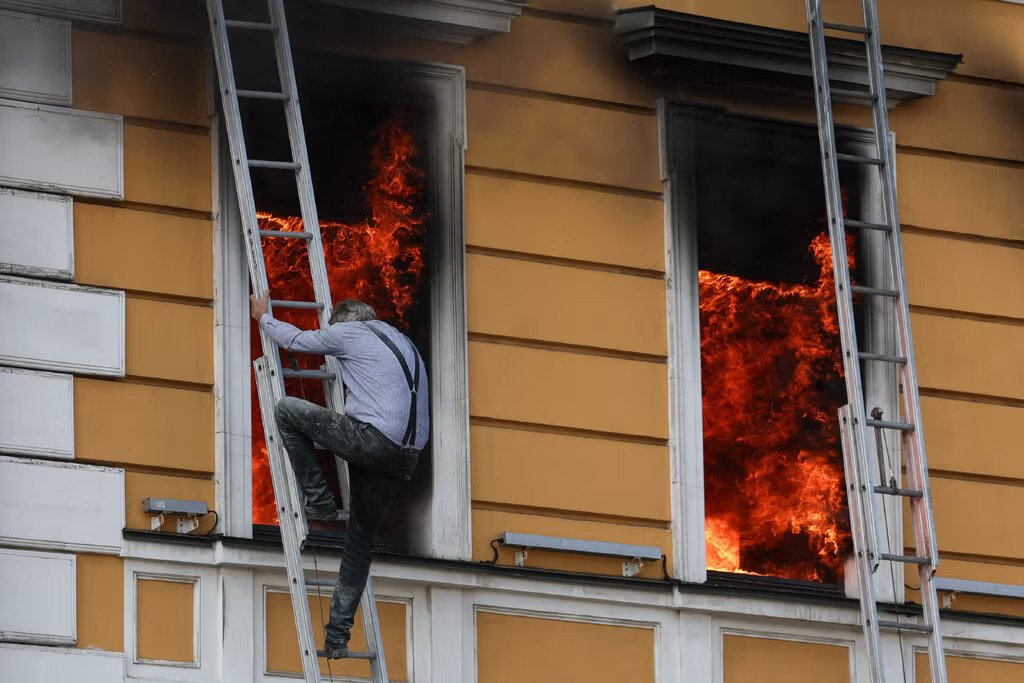
Image Courtesy: The New York Times
A Dangerous Threshold in the European Security Crisis
The conflict in Ukraine has transcended a localized territorial dispute. It is now a primary driver of a broader European security crisis.
The war is grinding through a volatile autumn. A disturbing new phase has taken root across the continent.
Moscow is systematically targeting civil, intellectual, and scientific institutions. At the same time, aggressive provocations are rising near NATO’s eastern frontier.
A daytime strike recently hit Kyiv’s historic National Academy of Sciences. This attack was paired with rising aerial alerts along the Polish border.
These events are not merely an escalation of tactics. They represent a fundamental stress test of European resilience and international deterrence.
ALSO READ: Navigating the Geopolitical Chessboard: Xi Jinping Tests Donald Trump with the “Thucydides Trap”
Moscow has pivoted toward daytime psychological terror. It is also deploying advanced jet-powered munitions.
This geopolitical analysis examines how these actions threaten to pull neighboring states into a broader continental catastrophe.
The Anatomy of Escalation: Weaponizing Daytime and Intellectual Life
For much of the full-scale invasion, aerial bombardments of urban centers like Kyiv followed a nocturnal rhythm.
Nighttime strikes allowed citizens moments of reprieve during daylight hours. People could maintain essential civic functions during the day.
Recent weeks have broken this pattern. Moscow has calculated a deliberate shift toward broad daylight attacks.
These strikes are designed to maximize disruption, psychological fatigue, and economic stagnation.
The strike on the National Academy of Sciences in central Kyiv serves as a grim emblem of this strategy.
The academy occupies a historic 19th-century intellectual hub. It stands near major diplomatic and cultural landmarks.
The building was struck while administrative and research staff were actively inside.
The resulting fire caused severe casualties. Injuries were sustained by former high-ranking security official and academy vice-president Volodymyr Horbulin.
These outcomes send a clear message. Moscow views intellectual and civilian leadership as legitimate instruments of psychological pressure.
| Strategic Vector | Operational Shift | Impact on the European Security Crisis |
| Daytime Bombardments | Moving from night-time infrastructure raids to daylight strikes. | Forces civilians to endure constant air-raid anxiety, disrupting work and institutional productivity. |
| Academic and Civil Targets | Striking research facilities, cultural landmarks, and medical centers. | Eradicates the illusion of sanctuary in urban centers; targets Ukraine’s future intellectual capital. |
| Advanced Propulsion | Deployment of high-speed jet-powered drones (Geran-4/5). | Overwhelms traditional acoustic-sensor networks and reduces warning times for civilian populations. |
As Anatoliy Zagorodny, president of the national academy, noted immediately after the attack, this was an act of terror.
Targeting a premier center of scientific research aims solely to grind down public endurance.
Technological Evolution: Why Jet-Powered Drones Worsen the European Security Crisis
The lethality of recent strikes is tied to rapid military-industrial adaptations. Russia is now integrating jet-powered loitering munitions and cruise-drone hybrids. These include the Geran-4 and Geran-5 variants.
Older propeller-driven models like the Iranian-designed Shahed series were slower. They operated at lower altitudes.
Ukraine’s mobile air-defense groups could track and shoot them down with heavy machine guns.
Modern jet-powered variants introduce severe defensive complexities that accelerate the European security crisis:
- Velocity and Interception Windows: These drones operate at significantly higher maximum speeds. They drastically compress reaction times for air defense units.
- Radar Cross-Section Profiles: Their aerodynamic designs allow them to evade standard low-altitude detection grids.
- The Interceptor Gap: Ukraine’s defense sector is racing to build fast, affordable interceptors. They must match these speeds without depleting scarce Western missile stockpiles.
This technological arms race leaves a widening gap between current air defense capacities and incoming aerial threats.
Borderlands on Edge: The Fragile Buffer With NATO
Kyiv bears the brunt of daytime terror. However, the geopolitical fallout of Moscow’s air campaign spills directly over western borders.
A jet-powered drone recently struck western Ukraine near a Polish border crossing. Warsaw immediately scrambled military aircraft. It also issued urgent shelter advisories in the Lublin region.
Russia routinely targets western logistics hubs and border transit points. This serves a double purpose.
It disrupts vital Western military and humanitarian aid. It also intentionally probes NATO’s collective resolve.
When explosive-laden drones operate kilometers from EU and NATO territory, the risk of escalation multiplies.
Stray debris or navigational failures can easily trigger an international incident. Polish military authorities emphasize that these proximity threats turn ordinary border regions into tense frontier zones.
Diplomatic Stalemates and Kremlin Attrition Strategy
These intensified bombardments align with a broader diplomatic freeze. US-brokered peace initiatives have stalled.
Meanwhile, the Kremlin openly states that Ukraine must pay a price for recent cross-border operations.
Moscow has doubled down on an attrition strategy. The logic within Russian military planning is straightforward. Inflicting continuous pain on civilian infrastructure breaks public will.
Destroying symbols of national identity like scientific and medical hubs aims to fracture Western political resolve.
President Volodymyr Zelenskyy continues to urge international partners to break this calculus. Total economic and diplomatic pressure remains necessary to stop further escalation.
Frequently Asked Questions (FAQ)
What building was hit during the Kyiv daytime strike?
A daytime Russian drone strike hit the historic National Academy of Sciences in central Kyiv. It caused a massive fire, killed at least one person, and injured several staff members.
How do jet-powered drones differ from older models?
Jet-powered drones like the Geran-4 and Geran-5 fly much faster and higher than older propeller-driven Shahed models. This severely reduces reaction times for air defenses.
Why are strikes near the Polish border causing international concern?
Attacks close to western border crossings threaten supply lines and risk direct territorial spillover into NATO member states, forcing Poland to scramble military aircraft.
How does this impact the wider European security crisis?
Attacks on civilian infrastructure and NATO border zones demonstrate that the war is no longer localized, threatening broader continental stability and demanding unified defense measures.
Final Thoughts on the European Security Crisis
Urban bombardment, intellectual targeting, and borderland friction point toward a troubling trajectory.
Scientific academies and medical centers have become frontline combat zones. The boundaries separating military necessity from state terror have vanished.
Treating these incidents as isolated tragedies is a dangerous miscalculation.
Unifying air defense architectures is now critical. Accelerating interceptor production and delivering an uncompromising diplomatic response are immediate prerequisites.
Europe must act decisively. Otherwise, a localized war risks metastasizing into a wider continental catastrophe.